
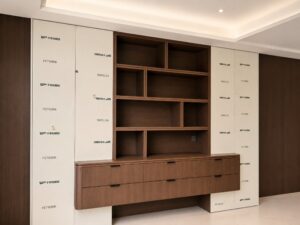
A tea-cabinet quotation should define the supplied parts in a written schedule, separating cabinet modules, loose components, optional items and room features outside the offer. A styled or project photograph does not establish the commercial supply boundary. Guanshi Millwork lists tea-room cabinets in its catalogue categories. Use that image as a visual reference, then ask the supplier to identify which parts belong to the exact cabinet proposal and how those parts will be described in the quotation and packing documents.
Give every supplied module a reference
Start with the proposed cabinet arrangement and give each module a clear identifier. A central shelving section, a drawer section and side cabinetry may need separate references if they are quoted, packed or reviewed separately. Ask the supplier to mark its proposed boundaries on a drawing. Do not infer those boundaries from a change in colour or a visible joint in the photograph. The supplier should identify the product it proposes to supply, including any parts that are excluded or depend on a further project decision.
Distinguish a complete module from the components inside it. Ask whether shelves, drawer parts, doors and related fittings are included in the proposed module or appear as separate items in the offer. If your brief requires a particular component, name it as a request and obtain confirmation rather than assuming it is standard. Keep the component list linked to the drawing revision. This makes it possible to understand whether a price change reflects a different module arrangement, an additional item or another unconfirmed part of the project.
Separate the cabinet from the surrounding room
Mark room features that are references only. Decorative objects, appliances, room lighting, wall treatments and other surroundings should not become assumed inclusions simply because they appear near a cabinet. If any such item is required, put it in a separate requested-scope field and ask which party is proposing to supply it. A cabinet photograph also does not establish whether an electrical item is included or how it should be installed. Keep any relevant technical coordination with the responsible project parties and obtain their version-specific information.
Ask the supplier to describe the proposed supply state: assembled modules, separately packed components or another defined arrangement. This is a commercial and packing question, not a set of assembly instructions. If loose fittings are proposed, request their item references, quantities and packing identity. Ask how the supplier will distinguish similar-looking parts that belong to different modules. Avoid assuming that a general custom-cabinet description includes every fitting, finishing item or site service needed for a particular project.
A supplied-parts schedule for the enquiry
Scope field | Buyer request | Supplier confirmation to obtain
Cabinet modules | Label each requested section | Included module list linked to drawing
Internal components | Name shelves, drawers or other requests | Included, optional or unresolved status
Loose fittings | Request an itemised proposal | References, quantities and packing identity
Room-reference items | Mark items outside the cabinet request | Explicit inclusion or exclusion
Supply state | Ask how modules will be delivered | Assembled or separately packed scope
Packing map | One reference per module and package | Contents cross-reference for receiving
Send the same schedule to each supplier participating in the enquiry. A buyer coordinating hospitality or residential furniture projects across UK and European destinations, for example, can retain a consistent supply-boundary record while requesting different documentation or commercial packaging. State those destination and project requirements separately. The schedule defines what is proposed for supply; it does not establish the cabinet’s material composition, emissions grade, load capability or compliance position. Request the appropriate information for those purchasing decisions instead of inferring it from the category name.
Make packing and revision records follow the scope
Ask for a packing proposal that maps packages to the accepted module and component references. If a project includes several cabinets, the package labels should make it clear which arrangement they belong to. Request a description of any protective packing relevant to the proposed contents without assuming a particular protective method is already included. A component photograph or packing diagram can help your receiving team interpret the shipment, while the written contents list defines the commercial items to be checked against the order.
Before ordering, compare the quotation, module drawing, component schedule and packing proposal using one revision reference. If a shelf, drawer section or other component changes, ask the supplier to update the affected fields and identify any commercial effect. For repeat supply, send the accepted schedule and request confirmation that the same parts and supply state remain available. Pricing, minimum quantities, timing and current options should be confirmed for that defined scope. Website images alone do not establish those terms or the exact contents of a future shipment.
FAQ
Does a tea-cabinet photograph define everything included?
No. Use it as an appearance reference and request a written module and component list. Mark surrounding room features separately so decorative objects, appliances or lighting cannot be mistaken for items included in the cabinet quotation.
Should loose fittings be listed even when modules are named?
Ask the supplier to define its supplied unit and identify any loose parts. A module name alone may not explain how it arrives or which separate items accompany it. Request references and quantities for the loose fittings included in the proposed offer.
Can the buyer assume the photographed finish identifies a material?
A visible finish does not verify substrate, surface process or material grade. Request the supplier’s proposed specification and supporting information for the selected version. Keep appearance selection and material confirmation as clearly linked but separate decisions.
What should accompany a revised component proposal?
Ask for an updated drawing or schedule identifying the changed part and its relationship to the other modules. The quotation and packing map should refer to that revision. Keep any unresolved item visible until the supplier and the responsible project parties confirm the scope.
Product reference and enquiries
Product category reference: https://gshimillwork.com/products/?product_filter=%e8%8c%b6%e5%ae%a4%e6%9f%9c
Catalogue source: https://gshimillwork.com/products/
Contact Guanshi Millwork: https://gshimillwork.com/contact/
More buyer articles: https://gshimillwork.com/blog/