
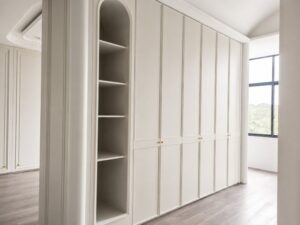
For a wardrobe order, define door handing with a labelled elevation and a stated viewing direction. Give each door leaf its own reference and ask the supplier to show its proposed opening arrangement. A message saying left door or right hinge is too ambiguous when teams view the cabinet from different sides. Guanshi Millwork lists wardrobes among its product categories; use that visual reference to start the enquiry, then request a drawing for the exact version being offered.
Choose a common view before using left and right
Name the view used for the instructions, such as looking at the wardrobe from the room-facing side, and mark that view on the drawing. Label the bays or sections before assigning individual door references. Ask the supplier to use the same labels in its response. This turns a relative instruction into an identifiable location. If the project uses another convention, document it rather than assuming it is shared by every designer, purchasing contact and factory team involved in the order.
Describe the requested door arrangement without inferring it from the category photograph. A closed-door image may show the number and appearance of visible panels, but it does not prove which ones open, where hinges are positioned or whether a panel is fixed. Ask the supplier to distinguish moving leaves, fixed panels and open sections in its proposal. Where a pair of doors is involved, give each leaf a separate reference so a comment on one side cannot be mistaken for a request affecting both.
Connect the opening map to the internal layout
Use the same bay references for the proposed shelves, drawers or other internal elements. Ask the supplier to identify any relationship between the opening arrangement and the interior configuration it is quoting. Keep the question tied to its actual proposal rather than specifying an unverified mechanism from a photograph. If the buyer’s design brief requires access to a particular compartment, identify that requirement on the drawing and ask the supplier to explain the proposed arrangement. Product capability still needs confirmation for the exact version.
Record adjacent project features separately where they may affect the proposed layout, using information provided and confirmed by the responsible project team. A site sketch can identify nearby walls or other furnishings without claiming that a catalogue wardrobe will fit an unmeasured space. Ask the supplier what additional information it needs to prepare its opening proposal. Keep any project-specific clearance or coordination questions visible. Do not assign a standard clearance, hinge range or installation allowance that the source has not established.
A door-handing schedule for the enquiry
Schedule field | Buyer reference | Supplier confirmation needed
Viewing direction | Named room-facing or agreed view | Same convention on all drawings
Bay identity | Number each cabinet section | Which section each leaf serves
Door leaf | Separate code for each moving panel | Moving leaf or fixed panel status
Opening map | Requested arrangement or open question | Proposed handing on a labelled drawing
Interior relationship | Linked compartment references | Layout associated with that proposal
Revision control | Drawing and schedule version | Changes affecting doors or interiors
Use the schedule to compare proposals across several rooms or developments. An importer coordinating UK and European furniture projects, for example, may receive drawings with different naming habits. A shared view and leaf code makes the order easier to interpret without relying on a regional shorthand. Send the destination and any required project documentation separately. The schedule identifies the requested arrangement; it does not establish the material, hardware grade, certification status or performance of the wardrobe offered by a supplier.
Review changes by leaf reference
When discussing a change, name the affected bay and leaf rather than writing reverse the door without context. Ask the supplier to return a marked revision showing the new arrangement and any related changes to the proposal. If a sample or presentation model is used, record which door references it represents. A finish sample cannot establish the opening arrangement, and an opening diagram cannot verify finish or hardware performance. Keep those decisions linked to the project while preserving their separate evidence and approval references.
Before ordering, cross-check the final door schedule, elevation and component proposal against the quotation. Ask how proposed substitutions or design revisions will be communicated, particularly if an interior layout or moving-panel arrangement changes. For repeat supply, send the accepted references and ask whether the same arrangement is being offered. Pricing, minimum quantities, packing and timing should be confirmed for that defined version. A wardrobe category image is a useful design enquiry reference, but it does not confirm availability or a complete hardware specification.
FAQ
Is a left-hinged instruction clear enough on its own?
State the viewing direction and identify the exact leaf on a drawing. Without those references, different teams may interpret the instruction differently. Ask the supplier to show its proposed arrangement using the same view and labels before the order specification is accepted.
Can hinge locations be inferred from a closed-door photo?
Use the photo for appearance reference, then request the actual opening map. The visible panels do not by themselves establish which ones move, where the hinges sit or what hardware is offered. Keep those fields as supplier confirmation questions.
Should a door reversal leave the interior plan unchanged?
Ask the supplier to identify any related change rather than assuming there is none. Link the leaf reference to its bay and interior proposal, then request a revised drawing showing how the new opening arrangement relates to those components.
What should accompany a door-handing change request?
Send the project reference, current drawing revision, viewing direction and affected leaf codes. Describe the requested change and ask the supplier to return a marked proposal. Keep the quotation and other schedules linked to the version your team actually accepts.
Product reference and enquiries
Product category reference: https://gshimillwork.com/products/?product_filter=%e8%a1%a3%e6%9f%9c
Catalogue source: https://gshimillwork.com/products/
Contact Guanshi Millwork: https://gshimillwork.com/contact/
More buyer articles: https://gshimillwork.com/blog/